Parking distances, without the guesswork.
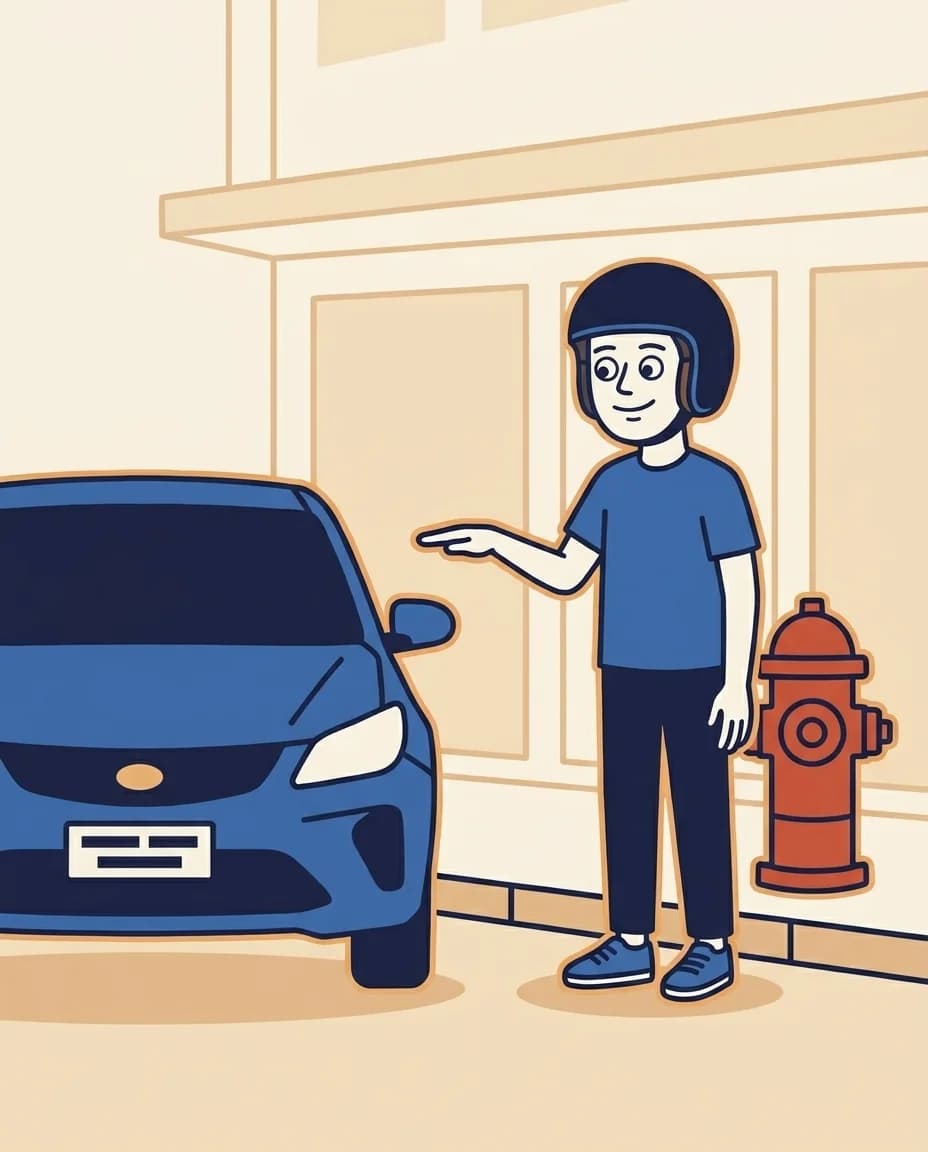
'Within X metres' wording in the Thai theory test marks a prohibited zone, not a target distance. You may not stop within 3 m of a crossing or hydrant, within 10 m of an intersection or signal, or within 15 m of a railway crossing.
Mascot standing between a parked car and a kerbside fire hydrant, right hand extended horizontally in a 'keep clear' gesture marking the gap that may not be filled.
Rule pattern
'Within X metres' means prohibited zone, never a target distance.
If a Thai theory question gives you a metre figure next to a hydrant, crossing, intersection, signal, or railway — the right answer is almost always 'you may not stop there.' Learn the matrix once and a whole category of questions collapses.
The Thai theory test loves exact metres. Here's where you can park, where you can't, and the numbers the wording is really asking about.
Written by a farang who failed once — independent of the Thai Department of Land Transport. About FarangDrive.
Sample questions
Try 5 parking & distances questions
Try a choice and the answer reveals inline, or open the panel directly. Exam-style wording, with the explanation right below.
Parking & distances
When parking on a road, how should you position your vehicle?
Show answer & explanation
Correct answer
A · Parallel to the road, close to the left-side curb
Thai law requires vehicles to park parallel to and close to the left-side curb. This keeps the vehicle clear of traffic flow and in line with left-hand traffic rules.
Parking & distances
You are parked on a downhill slope facing downhill. Which way should your front wheels be turned?
Show answer & explanation
Correct answer
A · Toward the curb
When parked facing downhill, turning the front wheels toward the curb means the curb acts as a stopper if the vehicle rolls forward. This prevents the car from rolling into traffic if the brakes fail.
Parking & distances
You need to park your car in a position that blocks another vehicle. How should you leave your car?
Show answer & explanation
Correct answer
B · In neutral with the handbrake released
When your car blocks another vehicle, you must leave it in neutral with the handbrake off so the blocked driver can push your car out of the way. Engaging a gear or the handbrake prevents the car from being moved.
Parking & distances
You are looking for a place to park near a busy junction. Which location is prohibited?
Show answer & explanation
Correct answer
B · At the junction or within 10 metres of it
Parking at a junction or within 10 metres of a junction is prohibited because it can block visibility and obstruct vehicles turning or crossing. Drivers must choose a legal parking place away from the junction.
Parking & distances
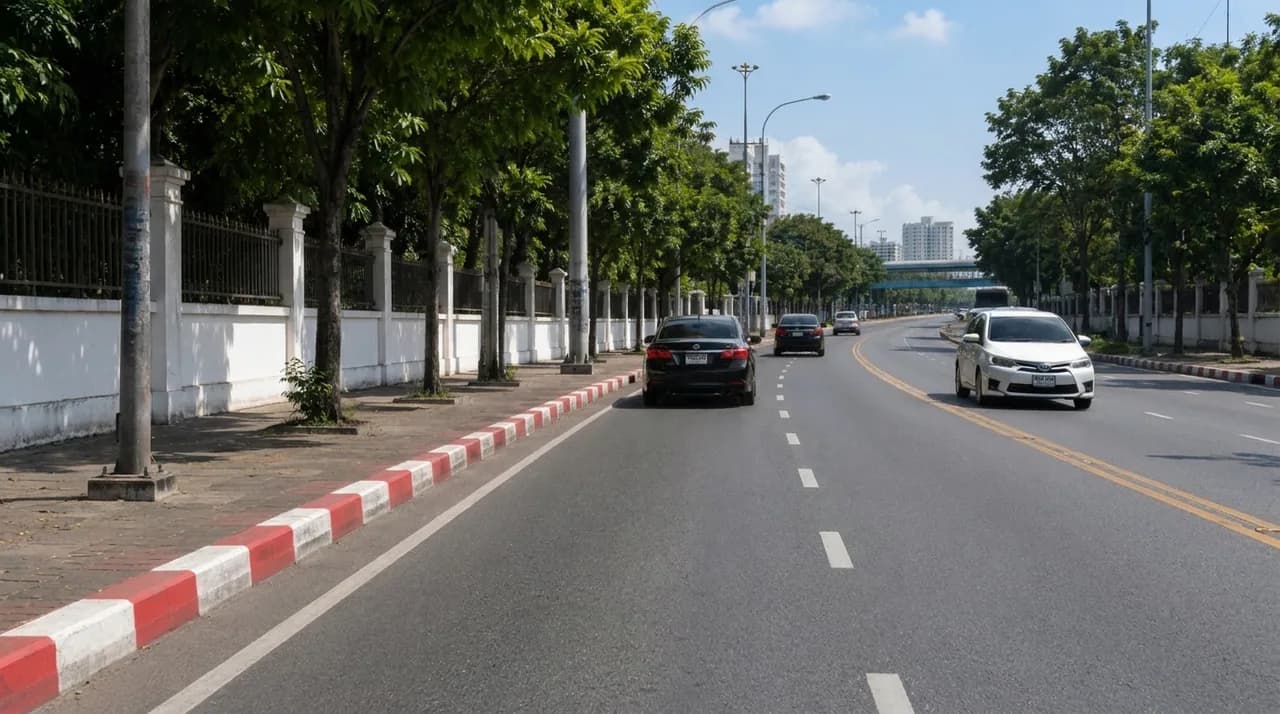
The kerb alongside this road is painted with alternating red and white stripes. What are drivers prohibited from doing here?
Show answer & explanation
Correct answer
A · Stopping or parking any vehicle
Red-and-white kerb stripes mean no stopping and no parking for any vehicle at any time. This is stricter than red-and-yellow stripes, which prohibit only parking.
The diagnostic mixes topics so you only practise what you’d miss.
Frequently confused
A · Red-and-white kerb
No stopping and no parking. Stricter than the red-and-yellow variant — applies to all vehicles, all the time.
B · Red-and-yellow kerb
No parking, but stopping briefly to pick up or drop off is permitted.
The difference: Red and white = don't even pause. Red and yellow = don't park, but a quick stop is okay.
Honest answers
Common parking & distances questions
Real questions foreigners ask before the theory test. Practice content is based on common Thai driving-test topics and public guidance; it is not an official exam database.
Does 'within 10 metres' mean I should park 10 metres away?
No. In these parking questions, 'within X metres' marks a prohibited zone. The answer is usually 'you may not stop there,' not 'park exactly X metres away.'How close to the kerb should I park?
Park parallel to the road and close to the left-side kerb unless signs or road markings say otherwise. The test is checking that you are out of the traffic lane, not floating away from the kerb.Why does the test ask so many distance questions?
Because exact numbers are easy to turn into multiple-choice traps. Learn the common distance figures together with the place they belong to, then the wording gets much easier.



Now run them under pressure.
Sample questions get you the wording. 5 on this page, hundreds more inside the diagnostic.